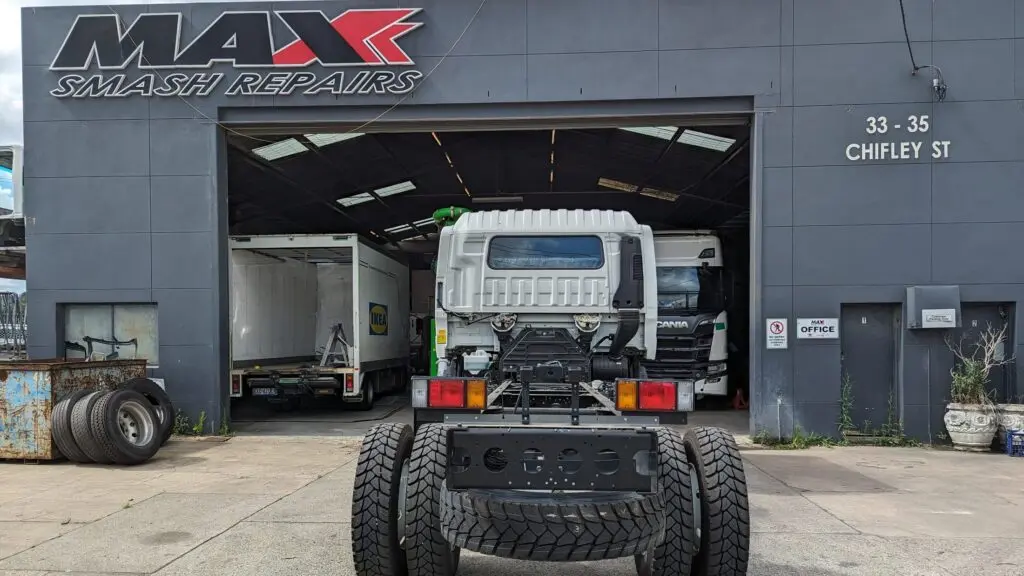
Truck body repairs cover everything behind the cab — the panels, posts, floors, rear doors and tail lift that make up the load area — and they are structural work far more often than they look. The National Heavy Vehicle Inspection Manual (NHVIM) deals with the body in Section 6, Structure and Body Condition, alongside the chassis. Damage that looks cosmetic from the kerb can still be a reason for rejection, so judge body damage structurally, not by how bad it looks.
What counts as the body on a heavy vehicle
The cab is one job and the body is another. On a rigid, the body is the pantech or dry-freight box, the curtain-sider frame, the flat tray and headboard, or the tipping body, plus the sub-frame that mounts it to the chassis rails. A prime mover has no body at all, which is why the damage pattern differs.
Body repairs split into three kinds of work, and it is worth knowing which you are buying. Panel work puts shape back into skins, posts and doors. Structural work restores strength to the frame, floor and sub-frame. Paint work puts the fleet colour back. We quote the three separately, so you can see what is holding the price. Equipment bolted to the body — curtains, refrigeration units, restraint gear — stays with its own suppliers; our side is panel, structural and paint work, plus tail lift and hydraulic repairs.
Body damage that can fail an inspection
NHVIM Section 6 sets out what an inspector is looking for. The criteria that catch damaged bodies most often are:
- A structural member cracked, broken or corroded far enough to weaken the vehicle (6.4a).
- A cab, body, sleeper or load area loose on the chassis, or missing fasteners (6.4b).
- A load area damaged, deteriorated, corroded or distorted so that part of the load is not retained (6.4c).
- Any door, gate, hatch or compartment latch, control or hinge damaged, badly worn, insecure or inoperative in any latching position (6.4d).
- Chassis or sub-frame parts cracked, distorted, sagging, loose or broken (6.7a), or fastenings and welds between frame members missing, loose or cracked (6.7b).
- Body mounting that does not follow the manufacturer’s recommendations or VSB 6 — brackets bolted to the flange of a chassis rail are specifically called out (6.7f).
- Mudguards that no longer cover the full width of the tyres (6.1c).
Load restraint is the other reason not to leave body damage. The NHVR’s guidance on the key elements of a load restraint system asks operators to check that vehicle structures and restraint equipment are in good working condition, and notes that even minor wear and damage can reduce capacity. A bent headboard or a torn securing point is part of that system. Whether a repaired securing point still carries its original rating is a question for your inspector or engineer.
Why filler is not a body repair
This is where cheap body work comes undone. The NHVIM divides a vehicle into primary and secondary structure, and it is stricter than most people expect: every floor panel is primary structure, as is the area within 100mm of door and bonnet hinges and locks. Body repairs must follow recognised industry methods and restore the original strength, and filler alone is not acceptable on primary structure.
Inspectors check for exactly this. The manual tells them to probe under-body areas such as sub-frames and suspension mounts with a rod, and to run a magnet over suspect repairs to find filler or fibreglass hiding a hole.
Doing it properly means cutting damaged metal out and letting new metal in. We fabricate sheet metal in-house for that reason, so a floor section, corner post or door skin can be made to suit rather than filled. Fibreglass panels are repaired as fibreglass, and small contained damage can be handled as a smart repair with infrared lamps. Where the hit has moved the chassis or sub-frame, the rails are straightened and the vehicle checked on our laser chassis and axle alignment equipment before anything is refitted.
Rust in a truck body
Rust is judged by depth and by location. On primary structure, floors included, surface rust is acceptable but advanced and extensive rust is not. On secondary structure the standard is more forgiving, except within 100mm of hinges and locks, where advanced rust fails, and anywhere extensive rust has created a hazard such as sharp edges or loose panels.
In practice a rusted floor or post is a cut-and-replace job, not a patch-and-paint one — and the sensible moment to deal with it is while the body is already apart for accident damage.
How a body repair runs
- Assessment from photos. Upload up to 20 photos and the vehicle details through our online assessment. We reply with a realistic estimate, or say if the truck needs to be seen. If it can’t be driven in, we arrange pick-up and delivery.
- Strip and measure. Damaged panels come off so the frame, floor and body mounts can be seen. Hidden mount and sub-frame damage after a dock hit changes the quote.
- Structural repair first. Frame members, sub-frame, mounts and floor are repaired or replaced to restore strength. Nothing cosmetic happens until the structure is right.
- Panel and fabrication work. Skins, posts, doors and trays are repaired or fabricated and refitted, with latches and hinges checked in every latching position.
- Paint and refit. As an authorised PPG refinisher we mix and match to your fleet colour and spray in pressurised baking ovens sized for a prime mover cab or a full-length coach. PPG’s manufacturer lifetime paint warranty applies to the refinish.
Quotes are itemised, panel, structural and paint priced separately. If the numbers say a body is not worth repairing, we will tell you rather than start the job. We are an approved repairer for all major insurance companies, and our page on heavy vehicle insurance claims covers the claim side.
Repair, or a modification?
The NHVIM defines a modification as any change that takes the vehicle away from the manufacturer’s specifications; work that keeps it within them is repair. Common modifications under the VSB 6 codes need approval from an Approved Vehicle Examiner, and complex ones only from the NHVR. Re-skinning a body is repair work. Lengthening it, re-mounting it differently or re-rating the vehicle is not — check with an Approved Vehicle Examiner or the NHVR first.
Common questions
Does the body have to come off the chassis?
Only when the damage is under it. Panel and door work is done with the body in place. If the mounts, sub-frame or chassis rails have moved, the body usually has to come off to measure and repair properly.
Can a rusted body floor just be patched?
Floor panels are primary structure under the NHVIM and filler is not accepted there. Rusted sections are cut out and new metal let in, which is why we fabricate sheet metal in-house.
Will insurance cover body damage?
Accident damage usually falls under a heavy motor policy; rust and wear usually do not. Where a body has both, the quote separates them so the claim is clean. Check your policy, and check with your insurer about anything you are unsure of.
Do you work on fleets as well as single trucks?
Yes. There is more on our transport and logistics page, and on truck and prime mover repairs.
Get your truck body looked at
Max Smash Repairs is a family-owned heavy vehicle panel and paint shop, working from the same Smithfield premises since 1984 for operators across Wetherill Park, Prospect, Blacktown, Parramatta, Liverpool, Eastern Creek, Moorebank and greater Sydney. Send us photos for a quote, or call (02) 9756 5295, Monday to Friday, 8:00am to 4:30pm.