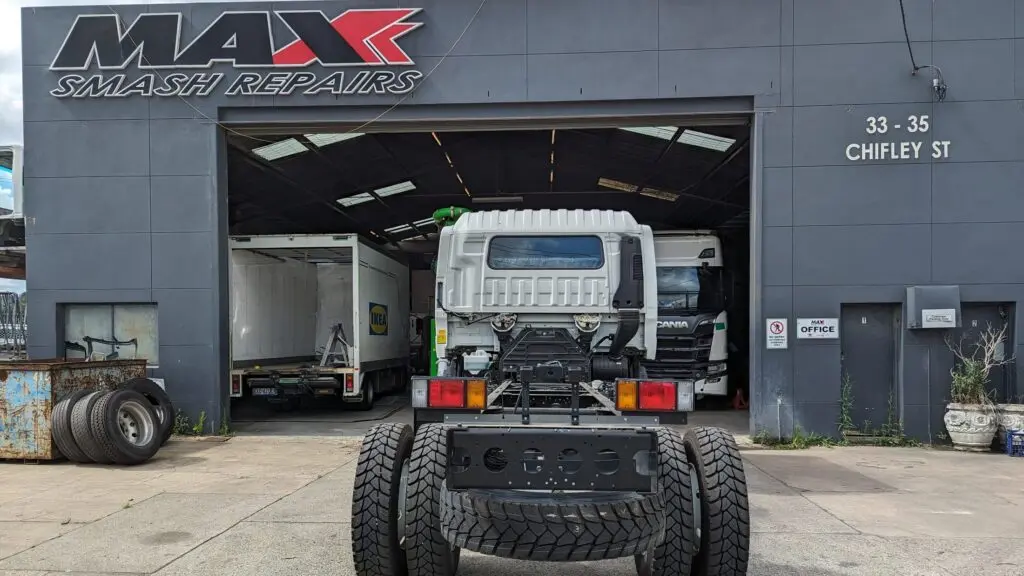
Running repairs across a fleet is a different job from fixing one damaged truck. The vehicle is one of many, the damage competes with every other job on your board, and the cost lands on a budget you have to defend. Fleet smash repairs work best when damage is treated as a process rather than a run of emergencies: a reporting standard your drivers will actually follow, records a workshop can quote from, and a clear rule about what comes off the road now and what waits for planned downtime.
Why fleet damage is a different problem
In a single-vehicle repair, the owner is the driver, the decision-maker and the person chasing the quote. In a fleet, those are three different people, and often three different days. Damage gets reported at the end of the week, the photos are missing, nobody wrote down the paint code, and the quote stalls while someone works out which unit hit which dock. None of that is a panel problem. It is an information problem, and it is the part you control.
Build a damage report your drivers will finish
A workshop can only quote what it can see. Most delays on fleet work come from a first report too thin to price, which means a second round of questions and photos before anyone can start. Keep the report short enough to finish at the end of a shift, and ask for the same things every time:
- Fleet number, registration, make, model and body type
- Date, time and place of the incident, and whether another vehicle or any property was involved
- Wide photos of the whole vehicle from both sides, so panel alignment and gaps are visible
- Close photos of each damaged area, with something in frame for scale
- Photos of anything that has moved but is not obviously broken: door gaps, step and handrail brackets, mudguard mounts, lamp surrounds
- Whether the vehicle was driven away, towed, or left where it stopped
- Whether it was loaded, and with what
That last point matters more than people expect: a loaded tipper or a crane with gear still on the deck changes how the vehicle has to be moved. Our online assessment takes up to 20 photos along with the vehicle details, and we reply with a realistic estimate or tell you if we need to see the vehicle in person.
Decide what comes off the road now
This is the decision fleet managers get wrong in both directions: parking a unit that only has a scuffed guard, or running one with damage that should have stopped it. Under the Heavy Vehicle National Law, the Chain of Responsibility makes everyone who works with heavy vehicles accountable for safety, not just the driver, and the Primary Duty is to ensure, so far as is reasonably practicable, the safety of your transport activities. A damaged vehicle in the yard with a job booked sits squarely inside that duty.
In practice, treat anything structural as off the road until it has been looked at: chassis rails and crossmembers, cab mounts, body framing, crane booms and outriggers. The same goes for damage affecting visibility or lighting, damage leaving a sharp or loose edge over a wheel or walkway, and anything that stops a door, an emergency exit or a lift working. Dents and paint damage that touch none of those can usually be planned around. Where it is not clear-cut, the call belongs to your competent person, engineer or inspector rather than the repairer, and if you are unsure whether a repair would cross into a modification needing approval, check the NHVR’s vehicle standards and modifications guidance.
Keep colour and specification records
Nothing exposes poor record-keeping like a repainted panel. Fleet white is not one colour, and a cab resprayed a few years ago may not be the shade the rest of the fleet left the factory in. We are an authorised PPG refinisher and do PPG colour matching and mixing so finishes stay consistent across a fleet, with PPG’s manufacturer lifetime paint warranty on the refinish. That works far better when you can tell us what was on the vehicle to begin with.
Worth keeping on file for every unit:
- The paint code for each vehicle or build batch, not just “white” or “corporate blue”
- Which panels have been repainted before, and roughly when
- Your livery artwork, and who supplies and applies it
- Build plate and any modification plate details
Batch the work that is not urgent
Minor damage accumulates. Kerbed steps, scraped guards, a torn mudflap bracket, a dented locker door: individually none of it justifies pulling a unit out of service, and collectively it is what makes a fleet look tired. Group the cosmetic work and bring it in against your own quiet periods, such as a bus operator’s school holidays or a plant hire business’s shutdown.
Itemised quoting helps here. We quote panel, structural and paint work separately, so you can approve the structural repair now and hold the cosmetic repaint for a planned slot. We will also tell you when a repair is not economically worth doing, which is a more useful answer than a quote you were never going to approve.
One workshop for a mixed fleet
Most fleets are not one kind of vehicle. A transport operator has prime movers and rigids; a civil contractor has a crane and a service truck alongside the plant. Max Smash Repairs handles trucks and prime movers, buses and coaches and cranes and heavy plant from the one Smithfield workshop, with laser chassis and axle alignment, paint baking ovens sized for a prime mover cab or a full-length coach, and in-house sheet metal fabrication and fibreglass repair.
We are a family-owned business that has worked from the same premises since 1984, we are an approved repairer for all major insurance companies, and we have long-standing relationships with Toll Global Logistics, Skell Hire and Komatsu Australia. There is more on how claims work on our heavy vehicle insurance claims page, and on what we do for transport and logistics operators. If a vehicle cannot be driven in, we will arrange pick-up and delivery.
Frequently asked questions
Who should report fleet damage, the driver or the workshop?
The driver, on the day, using the same form every time. Detail that was obvious at the depot is gone a week later. Give drivers a short standard list and a place to send the photos.
Can you quote fleet damage from photos?
Usually, yes. Send up to 20 photos and the vehicle details through our online assessment and we will come back with a realistic estimate, or tell you if the vehicle needs to be seen here. Structural damage is the most common case where photos are not enough, because the frame has to be measured.
Will a repaired panel match the rest of the fleet?
That is what colour matching and mixing is for, and it is much easier when you know the original paint code and whether the panel has been sprayed before. Tell us about the livery as well, so panel lines and artwork are planned together.
Do we have to use the repairer our insurer nominates?
It depends on the policy. Some heavy motor policies include a choice of repairer and others nominate one, so check your policy wording or ask your insurer or broker. We are an approved repairer for all major insurance companies.
Get your fleet damage quoted
Max Smash Repairs is a family-owned heavy vehicle panel and paint shop at 33–35 Chifley Street, Smithfield. Send us photos for a quote, or call (02) 9756 5295, Monday to Friday, 8:00am to 4:30pm. There are more answers on our FAQ page.